[Nadine Naber] also talked about how transgendered Arab feminists are being forced into terrible positions in bathrooms–when a woman assumes a transgendered woman is indeed an Arab male–the assumption then becomes “What is this Arab male doing in a woman’s bathroom? Is he there to blow the place up?” Thus, transgendered Arabs are not only dealing with the prospect of being beaten up for being a man in a woman’s bathroom, but also being arrested for being a terrorist in a womans bathroom. Naber wrapped up by saying that “an analysis of the lives of women and men doesn’t adequatly cover the experiences of all people” and it’s our jobs as radical women of color to begin examining how we can better confront these forms of violence in our organizing.
Showing posts with label arab americans. Show all posts
Showing posts with label arab americans. Show all posts
29 January 2007
Using the Restroom while Arab & Trans
From Women of Color Blog (emphasis mine):

24 January 2007


23 January 2007
Girl Germs
Arab women bloggers have been speaking directly to my heart this week! Amal at Improvisations: Arab Woman Proggressive Voice writes:
I was reminded of such a life-changing moment this morning. I was 14. Your typical painfully self-conscious, self-centered, angular, awkward girl. A "good girl" to boot: the "from home to school" type, with the occasional visit to a friend's house. One day on such a visit, I ran into my friend's parents sitting with other relatives. Doing what I'm expected to do, I approached them to shake hands, as it is the habit. When I extended my hand to the father, my hand just hung there. All alone. Not met. Spurned. Rejected. Embarrassed. Humiliated. The man muttered a quick greeting that I didn't hear. I went deaf. I became all Hand. Hands don't have ears or mouths or eyes. But, god, do they feel!!I don't have anything more to add at this time, but this post did get me thinking about Muslim and Arab cultural niceties expected of young women. I am Arab American, emphasis on the American, and when I went to Amman in 2000 I was sixteen and hadn't learned these niceties. I don't know if you've ever had the pleasure of being the only one in a large group of people for an extended period of time who isn't acclimated to their social mores and modes of interaction--if you are an immigrant maybe you know what I'm talking about--but it's not easy. When I accepted gifts from people and was later told that when someone offers me something, I am supposed to refuse it at first and only accept if they insist, I was so embarrassed. When my Tata hissed at my cousins and I, saying we were like whores because we were laughing on the street, I felt stifled by all the rules. When I kissed a distant uncle, who I hadn't seen since I was nine, and my aunt told me I shouldn't greet men that way, I thought, "Damn, I can't do anything right." And to this day I get slightly upset when strangers [who are Arab or who I perceive to be Arab] offer me things, like for example their chair at a crowded event, because I almost feel as thought I'm being tricked! On Fridays when I pass the men leaving the Islamic Center by my house, I keep my eyes down, but when I am in the street with my friends I talk and laugh as loud as I want to.
The whole encounter took seconds but lasted a life time. That was the first time I learned that some Muslim men won't shake my hand. Even at 14 I have shaken many a man's hand--cousins, uncles, family friends, neighbors, strangers--but this was my first encounter with a Muslim man who refused to shake hands.
I didn't like it. I didn't like it one bit. I wasn't interested in knowing the theological justification for it; I didn't do research to see which Muslim school allowed a man to shake hands with a woman and which didn't. I didn't give a damn. I only cared about how it made me feel--about my body and my female being. It wasn't a good feeling. I wanted to disappear and wished the ground would open and swallow me. I shrank, physically and psychologically. I wished I had no hands, no breasts, no lips, no eyes, no thighs, no vagina. I wished I were nothing.
And I smarted for weeks. Exactly the way I smarted years later when a jerk grabbed my breast in a crowded street in the Old City of Jerusalem.
20 January 2007
Born Palestinian...in America
I often feel that, as people of color, our authenticating factor is the extent to which we've suffered due to our status as people of color, and also the specific ways in which we've suffered. And the more we have suffered in those ways, the more authenticly Other we are. If we have not suffered a sufficient amount in those specific ways, our authenticity is called into question. This can be a self-conscious feeling and/or actually expressed by other members of our group. Both our right to inclusion in our group and the work we do to help our communities might be called into question based on any educational, economic or citizenship privileges we may have or be perceived as having.
It seems that being Palestinian is synonymous with suffering, but what about being a '48 Palestinian who grew up somewhere else, who's parents grew up somewhere else? What about being a Palestinian American? Al-Falasteenyia's recent post summed up a lot of things that I have been thinking about recently.
It seems that being Palestinian is synonymous with suffering, but what about being a '48 Palestinian who grew up somewhere else, who's parents grew up somewhere else? What about being a Palestinian American? Al-Falasteenyia's recent post summed up a lot of things that I have been thinking about recently.
What does being Palestinian mean to me? I hadn't thought of it specifically before. To me, identifying as Palestinian in the US is important because it increases visibility, it let's people know that, yes, we do exist.
And as I walked I began to imagine what would happen if these streets were filled with the IDF tanks…enforcing a curfew- locking everyone indefinitely in their apartments. What if soldiers vandalized these very shops- kill these very pedestrians-….and I tired to picture myself living, witnessing 1948. It’s one thing to always talk about it, but I am sure it’s nothing like being there, seeing it. It is like how I always talk about Palestine, and my identity as a Palestine, totally disconnected from the events that continue to effect me and shape who I am.
...
Looking back it, I was used to (and still am) experiencing Palestine in academic settings, intellectual panels/convo’s, and activism....that had shaped my identity. But all this was gone now, as I sat in a huge room with other Palestinians, waiting. Right then and there, I lost my identity. To be a Palestinian meant sitting at borders and checkpoints, it meant living it everday- and not through reading the news, or being an activist, or wearing a hatta, or thinking about Palestinians “over there”. It meant “being there”….and I know this issue has come up before in previous posts I’ve written- on being, or not being, a Palestinian. It’s just that this term has come to mean so many things….my life is different from other Palestinians in that I do not experience apartheid everyday. I acknowledge it of course, campaign against it, but I don’t actually experience it. and my brief 4 day journey into Palestine, was barely an experience….it was like the tip of the ice berg. On the other side of things, as an American, my ethnic background is always questioned: and people can never guess- I mean they try to- I’ve been previously classified as Russian, Romanian, Canadian, French, Spanish, Italian, British, Iranian, Albanian, Greek, Latina….i can go on- but the point here is classification. Everyone here in America must be classified (on a societal level). If you are multiracial, well people want an explanation….I’ve found out that they can’t not know your background. They want to know- and this is true of everyone. It only becomes an issue when the observer takes a look at u and cant decide right away if you’re black, white, or Dominican. So they become confused….afterall, how else are they to interact with you? And in these cases, after a few guesses I do not hesitate to tell people I’m Palestinian. For example, at the Doc’s office one of the technicians asked me and she seemed puzzeled at my answer…like she’s never heard of such a thing. Her colleuage turned to her and said, “Palestinian! Don’t you know? Palestine, next to Israel…” Then of course you have people who, no matter how many times you tell them you are Palestinian, insist that you are Pakastani- but I digress.
16 January 2007
“We’re friends?! You can’t even pronounce my name."
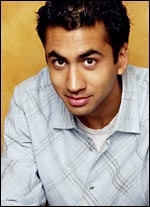 Earlier this evening I saw Kal Penn in a commercial for "24," a show I have never watched and didn't know he was on. As I learned, he plays a character that is new to the show, but familiar to viewing audiences worldwide: The brown Muslim terrorist.
You can read a recap of the episode at Sepia Mutiny, here: My Neighbor, The Terrorist. My favorite part?
When Mr. Wallace’s teenage son asks, “Why are you doing this? We’re friends,” Amar responds, “We’re friends?! You can’t even pronounce my name. It’s not Aw-med. It’s ACCCCCCH-med.”
Hahahahahahahaha!!! While the rest of this character's portrayal is riddled with stereotypes, this piece of it actually rings so true to me. I have actually said this to people before! And here we have the root of increased identification with terrorist groups among Western Muslims and other assorted brown people: The West's collective inability to pronounce our names, to show us respect and to count us as humans and citizens.
15 January 2007
Fears of Sectarian Violence in Detroit
Via the CulturalConnect:
Attacks on Detroit Iraqi Businesses--Revenge By Other Arabs?New America Media, News Report, Mohamad Ozeir, Posted: Jan 12, 2007
EDITOR'S NOTE: Recent vandalism of Iraqi-owned businesses in Detroit could be a retaliatory act by other Arabs for Iraqi Americans' recent celebration of the hanging of Saddam Hussein. Arab Americans trying to maintain a united front after Sept. 11 are worried the incident could split their community, writes NAM contributor Mohamad Ozeir.
DETROIT -- In what could be retaliation for some Iraqis' open celebration of the execution of Saddam Hussein, several Iraqi American-owned businesses and community offices on Warren Ave. in this city's west side were recently vandalized.
The damage, however, was more than the sum of the broken windows at three Shiite religious centers and nine stores and restaurants. It reveals fissures among groups within an Arab American community that is trying to maintain a united front following the Sept. 11 terrorist attacks.
As the news of Saddam’s execution on Dec. 30 was broadcast, hundreds of Iraqi Americans took to the streets here, dancing, chanting and waving the Iraqi flag. They celebrated the death of a dictator who drove them and their families into the desert after the uprising that followed the first American invasion of Iraq in 1991. CNN, Al Jazeera and other TV networks covered the community celebration live.
Most of the Shiite Iraqi community in Detroit originally came from southern Iraq, where the majority was pushed out of their homes by Saddam. They spent a few years in Rafha refugee camp in Saudi Arabia before they were granted visas to the United States.
A week after Saddam’s execution, the Shiite religious centers and businesses near where the celebration on Warren Ave took place, were vandalized. A security camera showed images of unknown persons carrying stones under their coats and smashing windows, according to the owner of one damaged store.
While Detroit police have not made any arrests and the Federal Bureau of Investigation is looking into the incident to determine if it is a federal offense, the nature of the assault is clear to its victims as a retaliatory act carried out by pro-Saddam elements against the Iraqi community.
“Judging from the targeted buildings, the message is clear,” says Ali Zwein, director of Al-Kufa Cultural Forum, one of the damaged religious centers.
The manager of Al-Rafedain restaurant, Sammar Ahmad, told reporters that she received threatening phone calls in both Arabic and English. Employees of other businesses gave similar accounts of prank calls and threats after the celebration.
News of the attacks was a top story for local television and newspapers, with mainstream media simply characterising them as a conflict between pro-Saddam Sunnis and anti-Saddam Shiites. Arab American organizations, however, kept a noticeable silence.
“It is obvious that the leadership of the establishment in the Arab community is lost somewhere between dismissal and denial,” says an Iraqi American activist, who didn’t want his name publicized.
Although Arab Americans have been victims of retaliation and racist attacks since Sept. 11, this incident would be the first reported case of violence within the community, if proved as the act of other Iraqis or Arab Americans.
Osama Siblani, publisher of the Arab American News and head of the Arab American Congress, told reporters, “I don’t believe it’s the Arab community that has done this.” However, he described the celebration of Saddam’s hanging as in “poor taste.”
Imad Hamad, director of the leading Arab American advocacy organization, the Arab American Anti Discrimination Committee (ADC), counseled caution, telling the Detroit Free Press, “I want to believe it’s isolated and it’s an act of ignorance. We don’t want people to panic and take it beyond what it is.”
Emad Alkasid, editor of the weekly Iraq Sun, says these kinds of statements show a double standard in the Arab American establishment. Both Siblani and Hamad are known to oppose the American invasion of Iraq and are very vocal in defending Arab American interests, but Alkasid was disappointed that both leaders did not take a stronger stance against the violence directed at the Iraqi community.
Touring some damaged places, Alkasid says, “No one (from the organizations) came here to show support. They did not even send reporters to cover the story. If this was done to other Arab Americans we all know how the organizations would react, but when it comes to our community, they don’t show any support because they don’t agree with our politics.”
Alkasid warns that “as Arab Americans we have suffered a lot of double standards by politicians and the media in this country and we should know better than doing the same to ourselves.”
The Arab media in the Middle East covered the incident, with an Agence France Press report saying the vandalism was triggering fears of sectarian violence between Sunnis and Shiites in the Detroit Area.
“The real fear in the community is not more violence along religious lines,” Alkasid says. “What we fear is the Arab American establishment considering us a second class community among Arab Americans.”
08 January 2007
Something Different than Survivor's Guilt
I am writing a longer article on the Unembedded exhibition of photojournalism from Iraq (which I previously blogged about here) and I'm looking for resources to help me to describe and analyze some of the things I felt while viewing the photos. Guilt is not something that I feel often, and I'm not sure if it is entirely accurate descriptor of what I mean (or maybe it's exactly accurate). And of course anger, sadness and outrage. I am looking for resources, be they scholarly works or personal accounts, on viewing images like these--of transgressions against one's people--from the position of survivor, 2nd+ generation, and perpatrator (whether original or 2nd+ generation). So far I have been researching imagery of lynching, slavery, the Holocaust and the Vietnam War, and I would appreciate any recommendations within or beyond these topics.
Viewing the experiences represented in the exhibition certainly put the discrimination that I experience as an Arab American in context real quick. I thought of last summer when my aunt described all these wars by saying, "This is the life of the Arabs," and then I thought when other family members say that I am not Arab because I am American, maybe it is true because I get to be safe from the wars. I had deep feelings of guilt then because of how unfair it is that I get to have all these basic priveleges that are denied to people who are the same as me. I look for ways that I benefit from the wars overseas so that I may examine my complicity in them, but I can't find them. I know who my allegience is to. I have no (familial or otherwise) connections to Iraq, but four years ago while I was working in the mall, someone's grandmother told me in Arabic that we are all Arabs now, and I still find that to be true. Iraq, Palestine, Lebanon; Even if you aren't my people, you're still my people. Looking at the photos of Iraq felt the same as looking at the photos of Lebanon last summer, even as I viewed the photos from Lebanon with Lebanese family members who had fled their home, felt the same as looking at photos of Palestine even as I imagine my grandfather's house and remember the stories my aunties told me when I was little.
Viewing the experiences represented in the exhibition certainly put the discrimination that I experience as an Arab American in context real quick. I thought of last summer when my aunt described all these wars by saying, "This is the life of the Arabs," and then I thought when other family members say that I am not Arab because I am American, maybe it is true because I get to be safe from the wars. I had deep feelings of guilt then because of how unfair it is that I get to have all these basic priveleges that are denied to people who are the same as me. I look for ways that I benefit from the wars overseas so that I may examine my complicity in them, but I can't find them. I know who my allegience is to. I have no (familial or otherwise) connections to Iraq, but four years ago while I was working in the mall, someone's grandmother told me in Arabic that we are all Arabs now, and I still find that to be true. Iraq, Palestine, Lebanon; Even if you aren't my people, you're still my people. Looking at the photos of Iraq felt the same as looking at the photos of Lebanon last summer, even as I viewed the photos from Lebanon with Lebanese family members who had fled their home, felt the same as looking at photos of Palestine even as I imagine my grandfather's house and remember the stories my aunties told me when I was little.
31 December 2006
Being an Arab Artist
Submitting work to an Arab American art exhibition has got me thinking about my role as an artist. In the past year or two, I was mainly interested in representing Muslim women, using family photos as source material. I think that initially I wanted to represent that part of myself. I don't cover, I don't practice Islam, but I am still like these women, I am made from these women and they inform who I am. I also wanted to show respect for the women who express their culture at all times, in a climate where nothing less than full assimilation is demanded. In the position I exist in, rendering a Muslim woman in the context of familial relationship is revolutionary because of the history of xenophobic colonialist representations of the Muslim
  woman. Because of what non-Muslims think when they see Muslim women. Because to wear hijab in this political climate is a revolutionary assertion of a non-Western identity. But I do not mean to glorify Islam or project something on to Muslim women who wear hijab as a whole that may not exist for them. I was raised to become a Muslim woman, but I never did.
My dad is Muslim and I went to Islam school as a kid. But I am American, and I am half white. I claim a Muslim cultural identity, but not a religious one, and I do not outwardly express this identity, unless you happen to catch me wearing the Hand of Fatima necklace my Tata gave me when I was small. In Islam the representation of living beings (animals and humans) is forbidden, so who else but me would make these kinds of images? Who else but me (and all the other mixed Arab American former Muslims who can relate) has access to this visual lexicon, to such a wide range of information about and perceptions of Muslim women?
 Thinking about this particular show, and the conference it will accompany (Diwan Arab Forum for the Arts, Arab American National Museum), of course there is concern--at least for me--of the ghettoization of Arab artists. At this point, I feel like these things are vital, although I hope I am able to get more out of this year's conference than I did last year's. I think, who else is going to support my work, like my work, buy my work? I worry that there are specific concerns that are deemed important for us as Arabs to address in our work, and from this will emerge an idea on what art made by an Arab American should look like, so that we will either have the choice of making "Arab
 American art" or making "art" period (i.e. "regular," white, Modernist leaning art). I worry that I am buying into this framework by creating images of Muslim women, especially with the image above, with the American flag motif. These questions are important for us to ask ourselves.
I have been slowly falling out of love with printmaking. In the past few months, I have been primarily into drawing, and even some painting (which I used to hate, and still think is overrated). Some concerns that have been floating around in my head and occasionally finding their way onto paper are mixed identity and multiculturality, interracial coupling and Islamic segregation of the sexes, and the idea of "looking" Arab (as seen in the first image in this post, which is called "Lori and Julie as Soumaya and Hanan," my white mother and her sister drawn as my Circassian/Palestinian aunt and her Palestinian friend). This coming semester I will be a part-time student for the first time in my academic career, and my one and only class will be Performance Art. I would like to use some of that free time to continue my work with fibers and begin experimenting with multiple media.
 thinking about my role as an artist. In the past year or two, I was mainly interested in representing Muslim women, using family photos as source material. I think that initially I wanted to represent that part of myself. I don't cover, I don't practice Islam, but I am still like these women, I am made from these women and they inform who I am. I also wanted to show respect for the women who express their culture at all times, in a climate where nothing less than full assimilation is demanded. In the position I exist in, rendering a Muslim woman in the context of familial relationship is revolutionary because of the history of xenophobic colonialist representations of the Muslim
  woman. Because of what non-Muslims think when they see Muslim women. Because to wear hijab in this political climate is a revolutionary assertion of a non-Western identity. But I do not mean to glorify Islam or project something on to Muslim women who wear hijab as a whole that may not exist for them. I was raised to become a Muslim woman, but I never did.
My dad is Muslim and I went to Islam school as a kid. But I am American, and I am half white. I
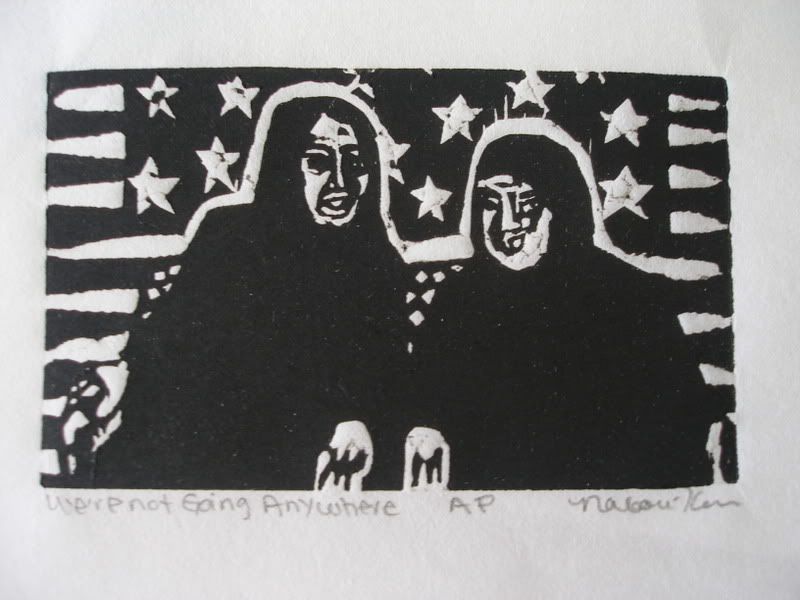 claim a Muslim cultural identity, but not a religious one, and I do not outwardly express this identity, unless you happen to catch me wearing the Hand of Fatima necklace my Tata gave me when I was small. In Islam the representation of living beings (animals and humans) is forbidden, so who else but me would make these kinds of images? Who else but me (and all the other mixed Arab American former Muslims who can relate) has access to this visual lexicon, to such a wide range of information about and perceptions of Muslim women?
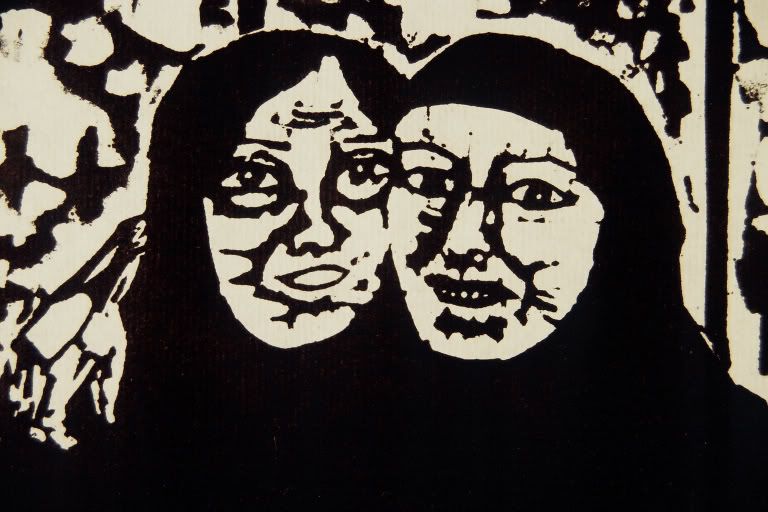 Thinking about this particular show, and the conference it will accompany (Diwan Arab Forum for the Arts, Arab American National Museum), of course there is concern--at least for me--of the ghettoization of Arab artists. At this point, I feel like these things are vital, although I hope I am able to get more out of this year's conference than I did last year's. I think, who else is going to support my work, like my work, buy my work? I worry that there are specific concerns that are deemed important for us as Arabs to address in our work, and from this will emerge an idea on what art made by an Arab American should look like, so that we will either have the choice of making "Arab
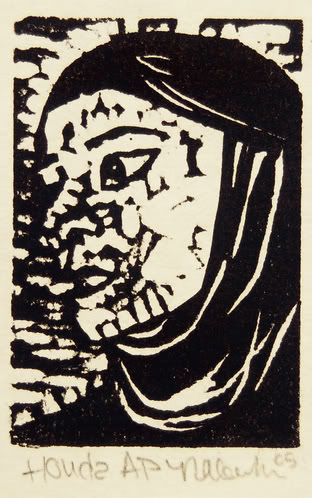 American art" or making "art" period (i.e. "regular," white, Modernist leaning art). I worry that I am buying into this framework by creating images of Muslim women, especially with the image above, with the American flag motif. These questions are important for us to ask ourselves.
I have been slowly falling out of love with printmaking. In the past few months, I have been primarily into drawing, and even some painting (which I used to hate, and still think is overrated). Some concerns that have been floating around in my head and occasionally finding their way onto paper are mixed identity and multiculturality, interracial coupling and Islamic segregation of the sexes, and the idea of "looking" Arab (as seen in the first image in this post, which is called "Lori and Julie as Soumaya and Hanan," my white mother and her sister drawn as my Circassian/Palestinian aunt and her Palestinian friend). This coming semester I will be a part-time student for the first time in my academic career, and my one and only class will be Performance Art. I would like to use some of that free time to continue my work with fibers and begin experimenting with multiple media.
26 December 2006
Are Arabs Funny?
I am excited for this! Check for it January 15th, 2007
here.
here.
Middle Eastern-American comedians making Comedy Central's "The Watch List"
Can an Arab be funny? Can a Muslim tell a joke? Can an Iranian make you laugh?
Find out on "The Watch List," the groundbreaking new comedy show that will be available January 8, 2007 on Comedy Central's Internet channel Motherload. This edgy comedy show features the country's top Middle Eastern-American comedians performing stand up and sketch comedy.
This is the only place where you can find out if "Arabs are the new blacks," see a real virgin Palestinian-American Muslim comedian, get a taste of what its like to "fly while Muslim," and find out if the President of Iran is high.
The Watch List is the first show ever produced by a major American entertainment company starring all comedians of Middle Eastern-American heritage including Maz Jobrani, Ahmed Ahmed, Maysoon Zayid, Dean Obeidallah, Aron Kader, Nasry Malak, Joe Derosa, Maria Shehata, Ronnie Khalil, Helen Maalik, and more.
The show was created by Arab-American comedian Dean Obeidallah and Emmy award winning comedy writer and best selling author Max Brooks.
Subscribe to:
Posts (Atom)


