Showing posts with label art. Show all posts

26 January 2007

Bettye Saar imagery at college "ghetto party"

Bettye Saar's The Liberation of Aunt Jemima (1972) reframes the ubiquitos image of the jolly, happy-to-serve "mammy" by suggesting--with the gun-- that, contrary to common modes of representing black life on screen and in print, black people are most definately not content and that, as suggested by the black fist, revolutions are being plotted and change is impending.

At Tarleton State University, in Stephenville, TX (about sixty miles from Dallas/Fort Worth, the city of my birth), some students saw fit to celebrate Dr. Martin Luther King, Jr.'s birthday by hosting a "ghetto party." From BREITBART.com(emphasis mine):

Photographs posted on social networking Web site Facebook.com showed partygoers wearing Afro wigs and fake gold and silver teeth. One photo showed students "mocking how African-Americans do step shows," Elder said. In another picture, a student is dressed as Aunt Jemima and carries a gun.

I immedietly thought of Saar's "The Liberation of Aunt Jemima," but I can only speculate on whether or not this student was familiar with the work. It's possible that she wasn't familiar with the imagery. A quick look at Tarleton State's website shows that they offer a BFA in Fine Art but no degrees in Art History, and no art history classes either. So then why include a gun with your Aunt Jemima costume? Because it's "gangsta?" And if this student was aware of the imagery her costume referenced, what exactly was the costume mocking? Attempts by black people to assert an identity in visual representation that is threatening to the white power structure? The desire to rise up and revolt? The anger of a people who have been owned, subjugated, abused and tortured by a white power structure and who continue to be negatively affected in multiple arenas of life by the same power structure?

In the photo I found, she has her hands full with a 40oz. and some syrup and there is no gun. You can view a slideshow of the images that were posted on facebook at The Smoking Gun.

For those who don't know, "ghetto parties" are events where a predominately white group of young people (I would say it is usually people of my generation, in their teens and twenties, who throw these parties) get together to eat fried chicken, drink malt liquor and mock any and all aspects of black culture. Even though I know that these parties exist, and I know of actual people who throw them and attend them, I always find myself a little surprised when I hear of new cases.

These "incidents" bring up issues of affirmative action and equality in higher education, as well as issues of equality in the judicial system. As Philip Arthur Moore notes in response to another "ghetto party" that occured at the University of Conneticut School of Law the weekend following Dr. Martin Luther King, Jr.'s birthday, "One thing that comes to mind is the reality that the legal system will one day be run by these people. Would it be a stretch to say, then, that the legal system is racist? Because these parties surely are." You can view the facebook photos of the UConn Law School party at The Smoking Gun.

Because these students were foolish enough to post these photos to the internet, we now have visual evidence of a lot of things we already knew. When these students thought about black life, and how to impersonate it, these are the things they came up with. When they think of black people, this is what they come up with. One student asserts that "the photos of the black students in attendance were not released to the media," but what this student fails to acknowledge is the pervasiveness of socialized self-hate and the reality that inclusion of people of color does not prevent a "ghetto party" from being racist. Another thing we already know is that these students will not be expelled, and will go on to have a better shot at available jobs than their non-white classmates, and their employers and family members will most likely write this off as just a crazy college party. At least this is what I think will happen, but I would love to be proven wrong.

[edit] from Racialicious: XXL has a good solution: New rule: if you make fun of ghettos, you have to go to one.

20 January 2007

Re: the D Exhibit

Come to the "Re: the D" exhibit this Friday, January 26th! The show is located in the new Wayne State University student run gallery (so new it doesn't have a name yet), which can be accessed by entering Old Main's (which is at the corner of Cass and Warren) side entrance, near the Elaine L. Jacobs Gallery. If you need further directions, check here. I have two pieces in the show.

31 December 2006

Being an Arab Artist

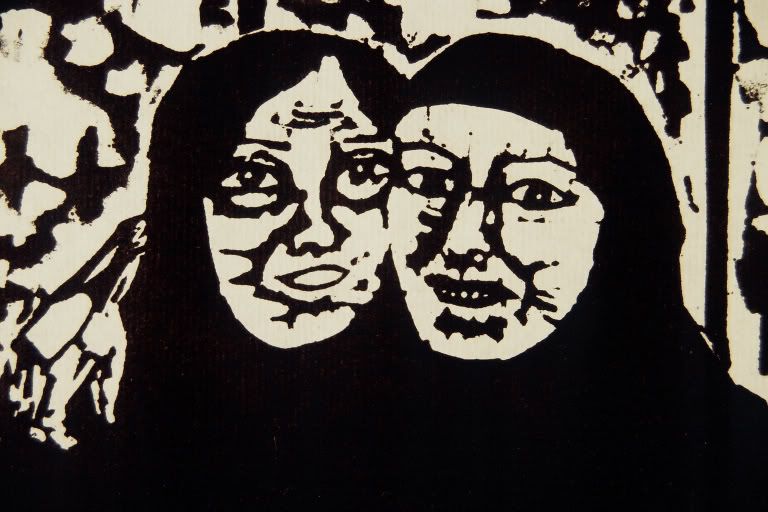
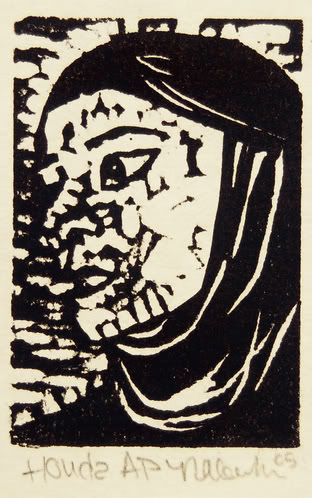
Submitting work to an Arab American art exhibition has got me thinking about my role as an artist. In the past year or two, I was mainly interested in representing Muslim women, using family photos as source material. I think that initially I wanted to represent that part of myself. I don't cover, I don't practice Islam, but I am still like these women, I am made from these women and they inform who I am. I also wanted to show respect for the women who express their culture at all times, in a climate where nothing less than full assimilation is demanded. In the position I exist in, rendering a Muslim woman in the context of familial relationship is revolutionary because of the history of xenophobic colonialist representations of the Muslim woman. Because of what non-Muslims think when they see Muslim women. Because to wear hijab in this political climate is a revolutionary assertion of a non-Western identity. But I do not mean to glorify Islam or project something on to Muslim women who wear hijab as a whole that may not exist for them. I was raised to become a Muslim woman, but I never did.

My dad is Muslim and I went to Islam school as a kid. But I am American, and I am half white. I claim a Muslim cultural identity, but not a religious one, and I do not outwardly express this identity, unless you happen to catch me wearing the Hand of Fatima necklace my Tata gave me when I was small. In Islam the representation of living beings (animals and humans) is forbidden, so who else but me would make these kinds of images? Who else but me (and all the other mixed Arab American former Muslims who can relate) has access to this visual lexicon, to such a wide range of information about and perceptions of Muslim women?

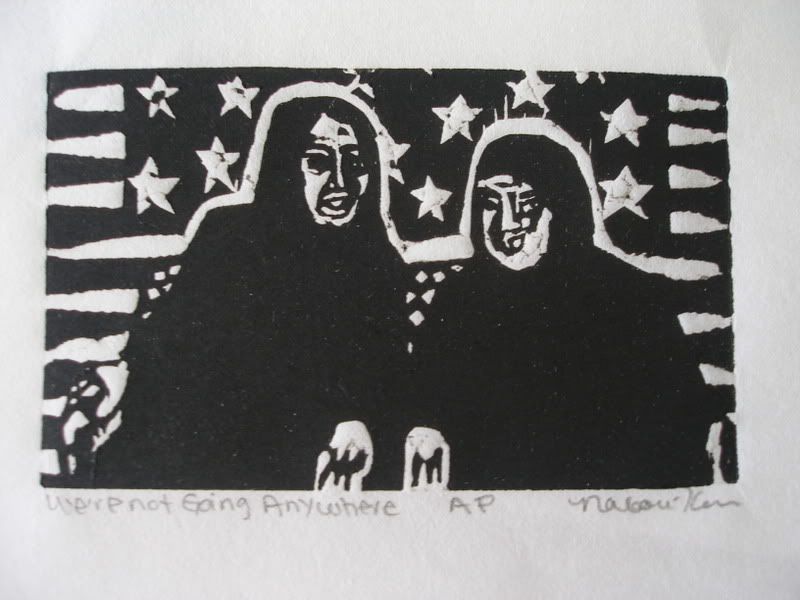
Thinking about this particular show, and the conference it will accompany (Diwan Arab Forum for the Arts, Arab American National Museum), of course there is concern--at least for me--of the ghettoization of Arab artists. At this point, I feel like these things are vital, although I hope I am able to get more out of this year's conference than I did last year's. I think, who else is going to support my work, like my work, buy my work? I worry that there are specific concerns that are deemed important for us as Arabs to address in our work, and from this will emerge an idea on what art made by an Arab American should look like, so that we will either have the choice of making "Arab American art" or making "art" period (i.e. "regular," white, Modernist leaning art). I worry that I am buying into this framework by creating images of Muslim women, especially with the image above, with the American flag motif. These questions are important for us to ask ourselves.

I have been slowly falling out of love with printmaking. In the past few months, I have been primarily into drawing, and even some painting (which I used to hate, and still think is overrated). Some concerns that have been floating around in my head and occasionally finding their way onto paper are mixed identity and multiculturality, interracial coupling and Islamic segregation of the sexes, and the idea of "looking" Arab (as seen in the first image in this post, which is called "Lori and Julie as Soumaya and Hanan," my white mother and her sister drawn as my Circassian/Palestinian aunt and her Palestinian friend). This coming semester I will be a part-time student for the first time in my academic career, and my one and only class will be Performance Art. I would like to use some of that free time to continue my work with fibers and begin experimenting with multiple media.

27 December 2006

Unembedded, Shirin Neshat and Botero

There are three topics in art that I am particularly interested in right now. The first is the exhibition and book, "Unembedded," which features the work of four independant photojournalists (two American, one Canadian, and one Iraqi). I was fortunate enough to have an oppurtunity to see the exhibition at my school at the Elaine Jacobs Gallery (who is showing Emily Jacir's Where We Come From in March). Because my favorite professor, Dora Apel, helped to bring the exhibition and two of the photographers (Kael Alford and Thorne Anderson) to my school, I was fortunate enough to be present for two lectures by them in one day, the first in my Contemporary Art Theory and Criticism class and the second in the lecture hall next to the gallery. You can read my thoughts on the exhibition in greater detail in the article I wrote for the Metro Times (one of our "weekly freebies" here in Detroit).

The second area of interest is the work of Shirin Neshat. Because I have never been fortunate enough to see any of her videos (other than this clip on YouTube), so my primary interest is her photography, specifically the "Women of Allah" series. I recently did TONS research on her work, representations of the veil, Western representations of Muslim women, and colonialist history in the Middle East and North Africa for a research paper I wrote on her work, which I am still editing and updating. Neshat is an Iranian immigrant to the US who's early photographic series "Unveiling" and "Women of Allah" deal with her reaquaintance to the new Iran after spening the years leading up to, during, and following the Islamic Revolution. She grew up in a secular Iran, and was shocked on her return because of the heavy idealogical basis of the Islamic Republic. In writing about "Women of Allah," I concluded that those images, which are almost exclusively shown in the Western world because that is where Neshat lives and works and because the Iranian government has exiled Neshat, draw upon a visual lexicon that can't be understood without sufficient knowledge of both Islamic culture and Western ideas about Muslim women, making this work multicultural without submitting to all the pitfalls immigrant artists in the West are often succeptible to, namely attempting to draw parallels between their two worlds and recycling visual motifs of both worlds in their work.

The third point of interest is Botero's new series, "Abu Ghraib," which are about the soldier photography we saw back in 2004. My mom was sweet enough to give the book to my boyfriend as a Christmas gift, so of course I consider it half mine. If you have a passing familiarity with Botero's work, you might find this an odd topic for him, like I did. But in the foreward of the Abu Ghraib book there are several examples of other politically motivated artworks of his, most often related to South American struggles. His style of rendering figures as heavy, voluptouos and massive is somehow able to feminize the torture victims while simultaneously making the aggressors hyper-masculine. I just began looking at these images last night, and I am sure I will have a lot more to say once I've more thoroughly reviewed them. As with the other two topics in this post, I will continue to write and think about them, and am very interested in other's opinions.

26 December 2006

Arab Female Artists

For my own reference, I'll keep updating this:

http://www.zinebsedira.com/
http://arts.guardian.co.uk/war/story/0,,924914,00.html
http://www.middleeastuk.com/culture/art/dialogues/
http://www.hammoude.com/