I was reminded of such a life-changing moment this morning. I was 14. Your typical painfully self-conscious, self-centered, angular, awkward girl. A "good girl" to boot: the "from home to school" type, with the occasional visit to a friend's house. One day on such a visit, I ran into my friend's parents sitting with other relatives. Doing what I'm expected to do, I approached them to shake hands, as it is the habit. When I extended my hand to the father, my hand just hung there. All alone. Not met. Spurned. Rejected. Embarrassed. Humiliated. The man muttered a quick greeting that I didn't hear. I went deaf. I became all Hand. Hands don't have ears or mouths or eyes. But, god, do they feel!!I don't have anything more to add at this time, but this post did get me thinking about Muslim and Arab cultural niceties expected of young women. I am Arab American, emphasis on the American, and when I went to Amman in 2000 I was sixteen and hadn't learned these niceties. I don't know if you've ever had the pleasure of being the only one in a large group of people for an extended period of time who isn't acclimated to their social mores and modes of interaction--if you are an immigrant maybe you know what I'm talking about--but it's not easy. When I accepted gifts from people and was later told that when someone offers me something, I am supposed to refuse it at first and only accept if they insist, I was so embarrassed. When my Tata hissed at my cousins and I, saying we were like whores because we were laughing on the street, I felt stifled by all the rules. When I kissed a distant uncle, who I hadn't seen since I was nine, and my aunt told me I shouldn't greet men that way, I thought, "Damn, I can't do anything right." And to this day I get slightly upset when strangers [who are Arab or who I perceive to be Arab] offer me things, like for example their chair at a crowded event, because I almost feel as thought I'm being tricked! On Fridays when I pass the men leaving the Islamic Center by my house, I keep my eyes down, but when I am in the street with my friends I talk and laugh as loud as I want to.
The whole encounter took seconds but lasted a life time. That was the first time I learned that some Muslim men won't shake my hand. Even at 14 I have shaken many a man's hand--cousins, uncles, family friends, neighbors, strangers--but this was my first encounter with a Muslim man who refused to shake hands.
I didn't like it. I didn't like it one bit. I wasn't interested in knowing the theological justification for it; I didn't do research to see which Muslim school allowed a man to shake hands with a woman and which didn't. I didn't give a damn. I only cared about how it made me feel--about my body and my female being. It wasn't a good feeling. I wanted to disappear and wished the ground would open and swallow me. I shrank, physically and psychologically. I wished I had no hands, no breasts, no lips, no eyes, no thighs, no vagina. I wished I were nothing.
And I smarted for weeks. Exactly the way I smarted years later when a jerk grabbed my breast in a crowded street in the Old City of Jerusalem.
Showing posts with label muslim women. Show all posts
Showing posts with label muslim women. Show all posts
23 January 2007
Girl Germs
Arab women bloggers have been speaking directly to my heart this week! Amal at Improvisations: Arab Woman Proggressive Voice writes:

09 January 2007
TONIGHT: Little Mosque on the Prarie
Don't miss "Little Mosque on the Prarie," tonight on CBC at 8:30pm. If you are a Comcast subscriber in Detroit, it's channel 99, and I think it's channel 9 if you don't have cable. It airs again tomorow (Wednesday) at 8pm.
CBC's Little Mosque to break new ground
n a show that will be the first of its kind on North American TV, CBC plans to begin a new comedy series about a small community of Muslims living in rural Saskatchewan.Yasir (Carlo Rota, left) and Baber (Manoj Sood, right) discuss the beginning of Ramadan, the month of fasting.
Little Mosque on the Prairie doesn't come to air until Jan. 9, but already it has attracted attention from the New York Times, the Los Angeles Times, CNN and satirical talk-show host Stephen Colbert.
The show's creator, Zarqa Nawaz, says she hopes the cheeky send-up of stereotypes and the clash of cultures will show Muslims in a new light.
"That Muslims can be funny and are just like everyone else," she said in an interview with CBC Television.
Little Mosque on the Prairie creator and producer Zarqa Nawaz.
(Sophie Giraud/CBC)A Regina-based mother of four, Nawaz says she hopes her children will see the new face of Canada in the show.
"I'd like them to be able to watch TV and see people who also look like them. So they can also connect that way," she said.
Shot in Toronto in 2006, the show focuses on a Muslim community in the fictional Prairie town of Mercy, following family conflicts and the community's interaction with their neighbours.
"It's based on my own observations growing up as Muslim in North America," she said.
Toronto-born actor Zaib Shaikh plays a young lawyer turned religious leader in the series.
The show isn't meant to be political, he said, and doesn't deal with political themes.
"It's a show that's meant to be funny, that shows an aspect of Canadian culture that just happens to be Muslim."
In one episode, a father fights with his adolescent daughter over what she can wear to school. In another, a battle of sexes erupts when a spiritual leader wants to put a divider between men and women in the mosque.
The show is a half-hour sitcom with humour arising out of the situations, Nawaz said, adding that her main goal is to get people laughing.
"Muslims have reacted very favourably to the show, because they want to see themselves on screen as real people," she said.
Nawaz was born in England, grew up in Toronto and moved to Saskatchewan 10 years ago. Her BBQ Muslims was a hit at the Toronto International Film Festival in 1996.
Actor Carlo Rota, who has a part in this show, as well as the hit U.S. series 24, says he thinks Little Mosque on the Prairie could only be made in Canada.
"I get heavy guys, bad guys, guys that garrotte, guys that strafe with machine guns," he says of his usual roles for TV.
American TV is too timid to make a show with such a fresh perspective, he said.
The show premieres next Tuesday and then will air on Monday nights and be repeated on Wednesday nights.
31 December 2006
Being an Arab Artist
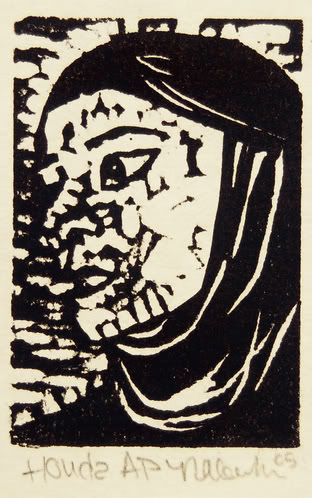
Submitting work to an Arab American art exhibition has got me thinking about my role as an artist. In the past year or two, I was mainly interested in representing Muslim women, using family photos as source material. I think that initially I wanted to represent that part of myself. I don't cover, I don't practice Islam, but I am still like these women, I am made from these women and they inform who I am. I also wanted to show respect for the women who express their culture at all times, in a climate where nothing less than full assimilation is demanded. In the position I exist in, rendering a Muslim woman in the context of familial relationship is revolutionary because of the history of xenophobic colonialist representations of the Muslim
  woman. Because of what non-Muslims think when they see Muslim women. Because to wear hijab in this political climate is a revolutionary assertion of a non-Western identity. But I do not mean to glorify Islam or project something on to Muslim women who wear hijab as a whole that may not exist for them. I was raised to become a Muslim woman, but I never did.
My dad is Muslim and I went to Islam school as a kid. But I am American, and I am half white. I claim a Muslim cultural identity, but not a religious one, and I do not outwardly express this identity, unless you happen to catch me wearing the Hand of Fatima necklace my Tata gave me when I was small. In Islam the representation of living beings (animals and humans) is forbidden, so who else but me would make these kinds of images? Who else but me (and all the other mixed Arab American former Muslims who can relate) has access to this visual lexicon, to such a wide range of information about and perceptions of Muslim women?
 Thinking about this particular show, and the conference it will accompany (Diwan Arab Forum for the Arts, Arab American National Museum), of course there is concern--at least for me--of the ghettoization of Arab artists. At this point, I feel like these things are vital, although I hope I am able to get more out of this year's conference than I did last year's. I think, who else is going to support my work, like my work, buy my work? I worry that there are specific concerns that are deemed important for us as Arabs to address in our work, and from this will emerge an idea on what art made by an Arab American should look like, so that we will either have the choice of making "Arab
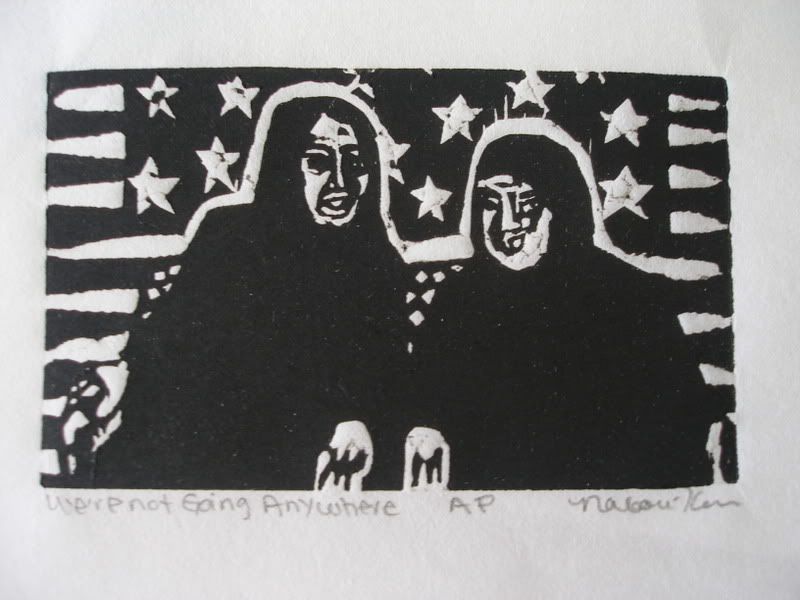
 American art" or making "art" period (i.e. "regular," white, Modernist leaning art). I worry that I am buying into this framework by creating images of Muslim women, especially with the image above, with the American flag motif. These questions are important for us to ask ourselves.
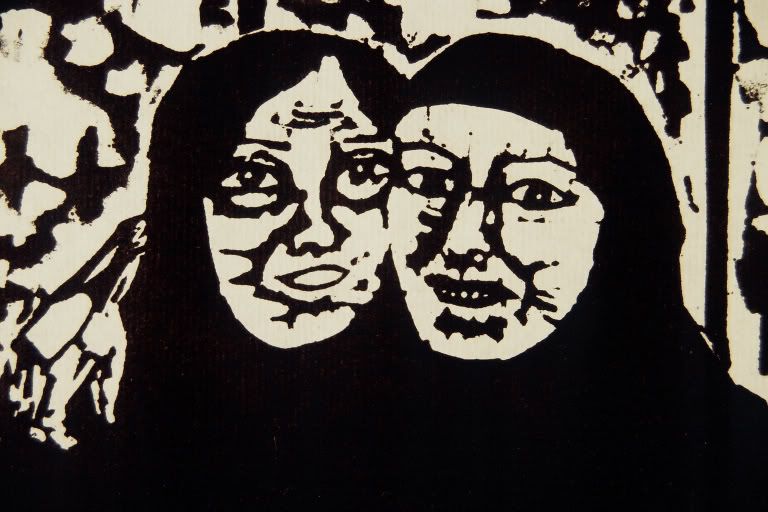
I have been slowly falling out of love with printmaking. In the past few months, I have been primarily into drawing, and even some painting (which I used to hate, and still think is overrated). Some concerns that have been floating around in my head and occasionally finding their way onto paper are mixed identity and multiculturality, interracial coupling and Islamic segregation of the sexes, and the idea of "looking" Arab (as seen in the first image in this post, which is called "Lori and Julie as Soumaya and Hanan," my white mother and her sister drawn as my Circassian/Palestinian aunt and her Palestinian friend). This coming semester I will be a part-time student for the first time in my academic career, and my one and only class will be Performance Art. I would like to use some of that free time to continue my work with fibers and begin experimenting with multiple media.
 thinking about my role as an artist. In the past year or two, I was mainly interested in representing Muslim women, using family photos as source material. I think that initially I wanted to represent that part of myself. I don't cover, I don't practice Islam, but I am still like these women, I am made from these women and they inform who I am. I also wanted to show respect for the women who express their culture at all times, in a climate where nothing less than full assimilation is demanded. In the position I exist in, rendering a Muslim woman in the context of familial relationship is revolutionary because of the history of xenophobic colonialist representations of the Muslim
  woman. Because of what non-Muslims think when they see Muslim women. Because to wear hijab in this political climate is a revolutionary assertion of a non-Western identity. But I do not mean to glorify Islam or project something on to Muslim women who wear hijab as a whole that may not exist for them. I was raised to become a Muslim woman, but I never did.
My dad is Muslim and I went to Islam school as a kid. But I am American, and I am half white. I
 claim a Muslim cultural identity, but not a religious one, and I do not outwardly express this identity, unless you happen to catch me wearing the Hand of Fatima necklace my Tata gave me when I was small. In Islam the representation of living beings (animals and humans) is forbidden, so who else but me would make these kinds of images? Who else but me (and all the other mixed Arab American former Muslims who can relate) has access to this visual lexicon, to such a wide range of information about and perceptions of Muslim women?
 Thinking about this particular show, and the conference it will accompany (Diwan Arab Forum for the Arts, Arab American National Museum), of course there is concern--at least for me--of the ghettoization of Arab artists. At this point, I feel like these things are vital, although I hope I am able to get more out of this year's conference than I did last year's. I think, who else is going to support my work, like my work, buy my work? I worry that there are specific concerns that are deemed important for us as Arabs to address in our work, and from this will emerge an idea on what art made by an Arab American should look like, so that we will either have the choice of making "Arab
 American art" or making "art" period (i.e. "regular," white, Modernist leaning art). I worry that I am buying into this framework by creating images of Muslim women, especially with the image above, with the American flag motif. These questions are important for us to ask ourselves.
I have been slowly falling out of love with printmaking. In the past few months, I have been primarily into drawing, and even some painting (which I used to hate, and still think is overrated). Some concerns that have been floating around in my head and occasionally finding their way onto paper are mixed identity and multiculturality, interracial coupling and Islamic segregation of the sexes, and the idea of "looking" Arab (as seen in the first image in this post, which is called "Lori and Julie as Soumaya and Hanan," my white mother and her sister drawn as my Circassian/Palestinian aunt and her Palestinian friend). This coming semester I will be a part-time student for the first time in my academic career, and my one and only class will be Performance Art. I would like to use some of that free time to continue my work with fibers and begin experimenting with multiple media.
Subscribe to:
Posts (Atom)


